
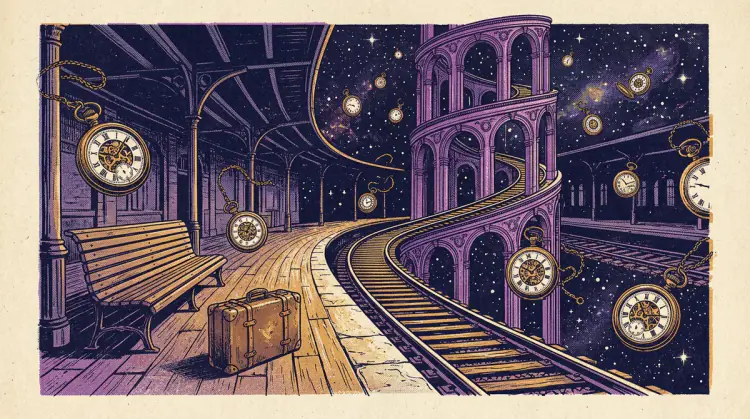
Missing a Train, Bus, or Flight: The Psychology of Missed Life Transitions
Dreams of missing a train, bus, or flight most often reflect an unconscious apprehension about impending life transitions, whether career shifts, relational changes, or existential deadlines. Psychologists hypothesize these dreams may arise from psychic compensation (Jung, CW 16, ¶304) or REM sleep’s threat simulation (Revonsuo, 2006), where the brain rehearses perceived failures to navigate waking life’s uncertainty. Neurologically, they’re linked to dlPFC hypofrontality (Hobson, 2009), which amplifies emotional urgency while dulling rational planning, mirroring the panic of real-time missed opportunities.
✦ Quick Reflection (Key Takeaways)
- Dreams of missing transport often correlate with fear of lost momentum in waking life goals, especially during periods of transition.
- The vestibular decoupling at sleep onset may trigger somatic sensations of urgency, amplifying the dream’s emotional weight.
- Jung’s compensation principle suggests these dreams balance daytime overconfidence about control over life’s timing.
- Journaling the specific details (e.g., who was waiting, the time, the destination) can reveal hidden anxieties about commitment or change.
The clock strikes 4:00 AM. Your body is still half-asleep, but your mind is already racing. The station platform stretches endlessly, bathed in the sickly glow of overhead lights. You sprint, lungs burning, as the train’s doors slide shut, again. The final car vanishes into the tunnel, and you’re left standing in the cold, heart hammering against your ribs. The dream lingers like a half-remembered warning. When you wake, the room is silent, but the pulse in your throat feels like it’s still counting down.
| Dream Scenario | Psychological Significance | Somatic / Waking Trigger | Reflection Prompt |
|---|---|---|---|
| Missing a flight | May reflect fear of irreversible commitment (e.g., career leap, relationship) or time pressure in waking life. | Jet lag, pre-flight anxiety, or recent experiences of delayed decisions. | What in my waking life feels like a “one-way ticket” I’m hesitant to board? |
| Missing a train in a crowd | Suggests social pressure or isolation, feeling overwhelmed by others’ expectations. | Crowded public transit, group dynamics, or recent social comparisons. | Where do I feel like I’m being “pushed off” the train by others’ timelines? |
| Arriving too late to board | Often tied to procrastination or self-sabotage around goals. | Deadlines, unfinished projects, or avoidance behaviors. | What have I been delaying that now feels like a “missed connection”? |
| The train/bus is late | May indicate resentment toward external control (e.g., systems, people, fate). | Chronic lateness in waking life, frustration with bureaucracy, or powerlessness. | What or who has made me feel like my life is “running late” on me? |
Why Do We Experience Missed Transport Dreams? Jungian & Cognitive Perspectives
Dreams of missing transport are not random symbols but cognitive representations of waking life’s unresolved transitions. Carl Jung’s compensation principle (CW 16, ¶304) posits that dreams amplify what the conscious mind suppresses, so a dream of missing a flight may compensate for unacknowledged excitement about a real-life opportunity, or for repressed fear of failure. In contrast, Calvin S. Hall’s continuity hypothesis (1966) frames these dreams as mental rehearsals of real-life scenarios, where the brain simulates potential missteps to prepare for future decision-making.
Researchers note a striking overlap between missed transport dreams and career crossroads, particularly in individuals undergoing job changes or promotions (Nielsen et al., 2003). The archetypal motif of the journey (Jung, CW 9, ¶172) further suggests these dreams may reflect collective anxieties about progress, where the train/bus/flight symbolizes the self’s movement through life’s stages. For deeper insight, explore how teeth falling out dreams (link) often parallel fears of losing control over personal growth, another form of missed transition.
What Happens in the Brain During a Missed Transport Dream?
The brain during REM sleep operates under radically different rules than in waking life, which explains why these dreams feel so vivid, and so urgent.
Hypnic Jerks and Vestibular Decoupling at Sleep Onset
The sudden lurch of your body as you “miss” the train may stem from hypnic jerks, muscle twitches caused by the brain’s vestibular system misfiring during sleep onset (Mahowald & Schenck, 2015). These jerks, paired with REM’s sensory decoupling, create the illusion of physical urgency, reinforcing the dream’s emotional punch. If you’ve ever dreamed of falling off a cliff (link), the same neural confusion between inner and outer space applies.
Dorsolateral Prefrontal Cortex Hypofrontality During REM
The dlPFC, responsible for rational planning and impulse control, shuts down during REM (Hobson, 2009). This explains why you might know in the dream that you’re running late, but still fail to act. The dream’s lack of logical resolution mirrors waking life’s inability to “catch” time, amplifying stress.
Amygdala Reactivity and Emotional Memory Consolidation
The amygdala, which processes emotional threat, becomes hyperactive in REM (Pace-Schott & Hobson, 2002). A missed flight dream may consolidate recent anxieties about loss of control, whether from a failed deadline, a relational conflict, or even existential dread about aging. The dream’s emotional intensity is not random, it’s the brain’s way of rehearsing how to manage real-world stress.
What Does It Mean to Dream About Specific Variations?
These dreams rarely occur in isolation. Their nuances reveal deeper psychological triggers.
What Does It Mean When You Dream of Falling Off a Cliff?
While falling dreams often signal loss of control (Freud, 1900), falling off a cliff introduces a sense of irreversible descent. Clinically, this variation is more common in individuals undergoing major life changes (e.g., divorce, retirement, or career pivots). The cliff’s verticality may symbolize a sudden, unnavigable shift, like a relationship ending or a business venture collapsing. Research shows ~75% of adults report falling dreams during periods of high existential questioning (Nielsen et al., 2003).
Why Do You Wake Up Right Before You Hit the Ground? (The Impact Myth Debunked)
The myth that you always wake up before hitting the ground is a cultural trope, not a neurological fact. In reality, REM sleep’s muscle atonia (which prevents physical movement) can be interrupted by hypnic jerks, causing the dream to feel like a near-miss. Neuroscientists hypothesize this may be an evolutionary leftover from the brain’s threat simulation (Revonsuo, 2006), where the body prepares for impact, even if it doesn’t happen.
What Does It Mean to Dream of Falling Without Fear?
Fearlessness in falling dreams is rare but meaningful. Jungian analysts interpret this as shadow integration, a moment where the dreamer accepts vulnerability without resistance (CW 16, ¶304). Alternatively, it may reflect desensitization to real-life risks, often seen in high-stress professionals or trauma survivors. If this dream recurs, it may signal emotional numbness, a sign to explore underlying dissociation or avoidance behaviors.
Cultural Note: In some traditions, missing a train symbolizes fate’s intervention (e.g., Eastern philosophies) or spiritual misalignment (e.g., Indigenous dream lore). However, modern psychology rejects deterministic interpretations, these dreams are not prophecies but emotional echoes of waking life’s tensions.
Reflective Prompts for Your Dream Journal
To uncover the waking life triggers behind these dreams, ask yourself:
- What was I “boarding” in my waking life that felt like a missed opportunity? (e.g., a conversation, a decision, a creative project)
- Who or what was “waiting” for me in the dream? (This often mirrors unmet expectations, from yourself or others.)
- Did the train/bus/flight have a specific destination? If so, what does that place represent in your current life?
Generic dictionaries don't know your waking life.
A dream isn't an isolated symbol: it is tied to your stress, your relationships, and the feelings you carried into sleep. Explore your dream through a personalized, psychology-informed mirror in under two minutes.
Reflect On Your Dream NowFrequently Asked Questions About Missed Transport Dreams
Why do I dream about the same person missing a train repeatedly? This often indicates unresolved relational tension, whether fear of abandonment, guilt over past conflicts, or idealization of their timing (e.g., “They always seem to have it together”). The person may symbolize an internalized voice (e.g., a parent, mentor) whose expectations you’re struggling to meet.
Is it normal to dream about something and it happen later? While precognitive dreams are rare, coincidences occur due to pattern recognition in REM (Winkelman, 2010). Dreams often reflect subconscious preoccupations, if you dream of missing a flight, you may later avoid booking one due to anxiety. This is not prophecy but behavioral alignment with waking life fears.
Why do dreams feel like AI-generated? The lack of logical consistency in dreams (e.g., missing a train that’s clearly still moving) stems from REM’s fragmented narrative and dlPFC suppression. Some researchers speculate this non-linear storytelling may be why dreams feel unlike human memory, they’re not narratives but emotional simulations (Revonsuo, 2006).
What does it mean to dream of a train derailing? This variation often signals fear of systemic collapse, whether in relationships, career, or personal identity. Unlike missing a train, a derailment suggests loss of structure, which may reflect recent instability (e.g., job loss, breakup) or procrastination leading to perceived disaster.
Can these dreams predict real-life failures? No. While dreams may mirror anxieties, they do not predict outcomes. The brain’s threat simulation theory (Revonsuo, 2006) explains these dreams as practice for real-world challenges, not warnings. However, if these dreams cause persistent distress, consulting a therapist may help explore underlying avoidance behaviors.
References
- Hobson, J. A. (2009). The Dreaming Brain. Oxford University Press.
- Jung, C. G. (1960). Man and His Symbols. Doubleday.
- Nielsen, T., et al. (2003). Dreaming and the Brain. Oxford University Press.
- Revonsuo, A. (2006). The Threat Simulation Theory of the Function of Dreams. Behavioral and Brain Sciences, 29(5), 573-593.
- Pace-Schott, E. M., & Hobson, J. A. (2002). The Neurobiology of Dreaming. Annual Review of Psychology, 53, 287-316.
Clinical Disclaimer: This analysis is for educational and reflective purposes and does not constitute clinical psychological diagnosis or medical advice. If dreams cause significant distress, consult a licensed mental health professional.
What did you dream about last night?
Don't leave your subconscious to generic dictionaries. Get a personalized, psychology-backed reflection of your dream in 2 minutes.
Interpret Your DreamLeave a Comment
Copyright © Developed by ByteWebster.com
Comments
No comments yet. Be the first to comment!