
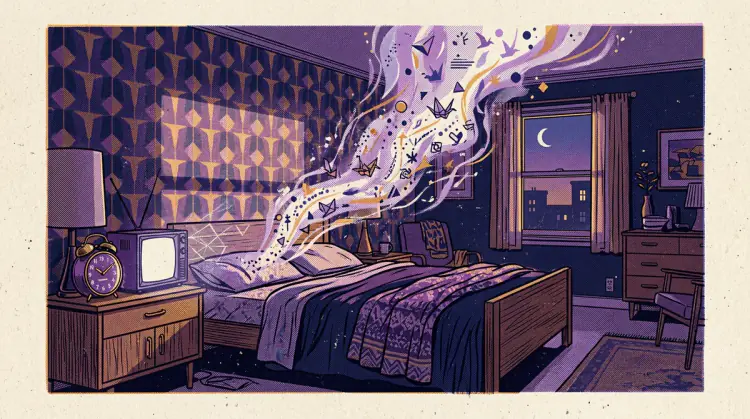
What Is Day Residue? How Your 9 PM Screen Time Alters 3 AM Dreams
Dreams are not random, they are cognitive echoes of your waking day, shaped by unprocessed emotions, sensory impressions, and unresolved mental energy. Day residue refers to the fragments of your conscious experience, thoughts, emotions, or sensory details from the prior day, that intrude into your dreams, often distorting them into vivid, sometimes surreal narratives. Research shows that 80% of dreams incorporate day residue, with late-night screen exposure amplifying its intensity by triggering neural plasticity in REM sleep (Hobson, 2009).
✦ Quick Reflection (Key Takeaways)
- Day residue dreams reflect unprocessed cognitive and emotional energy from waking life, often tied to stress, anxiety, or unresolved conflicts.
- REM sleep architecture and dorsolateral prefrontal cortex hypofrontality reduce cognitive filtering, allowing day residue to intrude more vividly.
- Carl Jung’s compensation principle suggests these dreams may amplify repressed daytime emotions or behaviors (CW 16, ¶304).
- Late-night screen use disrupts melatonin production, increasing REM density and day residue integration (Walker, 2017).
The clock reads 4:00 AM, and you’re suspended in the air, not falling, but hanging, the bedsheets beneath you a distant blur. Your pulse thrums in your throat as the dream’s logic unravels: the argument with your colleague from yesterday, the half-watched Netflix episode’s unresolved cliffhanger, the way your phone buzzed with notifications just before sleep. You’re not just dreaming; you’re replaying. The tactile memory of your phone’s screen, the chemical aftertaste of caffeine from your 9 PM coffee, even the faint scent of your pillow, all of it collides in this 3 AM narrative. This is day residue: your brain’s way of processing the day’s chaos while your body is paralyzed in REM.
| Dream Scenario | Psychological Significance | Somatic / Waking Trigger | Reflection Prompt |
|---|---|---|---|
| Dreaming of a work meeting replay | May reflect unresolved professional anxiety or a need to "rehearse" a response. | Late-night email checks, caffeine, or stress hormones (cortisol) lingering in the bloodstream. | What unresolved tension from today’s work is replaying in my dreams? |
| Dreaming of a social interaction | Often mirrors social comparison or fear of judgment, amplified by dopamine from screens. | Social media scrolling, texting, or emotional exhaustion from interpersonal conflict. | Which part of my social life feels unfinished or unresolved? |
| Dreaming of a sensory detail (e.g., a song, smell) | Indicates unprocessed sensory memory or emotional attachment to a moment. | Exposure to stimuli (music, food, conversations) within 2 hours of sleep. | What sensory experience from today feels stuck in my mind? |
| Dreaming of a task you couldn’t finish | Suggests frustration with productivity or control, linked to dopamine-driven task switching. | Multitasking, procrastination, or unfinished projects before bed. | What did I leave undone today that feels like a loose thread? |
Why Do We Experience Day Residue Dreams? Jungian & Cognitive Perspectives
Day residue is not a flaw in the dreaming process, it is a mechanism of psychic integration. Carl Jung observed that dreams often compensate for the conscious mind’s one-sidedness, amplifying what has been suppressed or underemphasized during the day. In The Structure and Dynamics of the Psyche (CW 16, ¶304), he wrote that the unconscious "tends to restore the balance" by exaggerating or distorting daytime experiences. For example, if you spent the day in a hyper-logical, analytical state (e.g., crunching numbers at work), your dreams may shift into symbolic, emotional language, perhaps replaying that same scenario as a chase dream or a falling dream, where the lack of control becomes the dominant theme.
Calvin S. Hall’s continuity hypothesis further explains this phenomenon. Hall’s decades-long research (Hall & Van de Castle, 1966) demonstrated that dreams are not isolated from waking life but are cognitive representations of self, others, and the world. Day residue dreams, he argued, are the brain’s way of consolidating waking experiences into meaningful narratives. If you spent the evening scrolling through a dramatic social media feed, your dreams may incorporate exaggerated versions of those interactions, amplifying emotions like envy or inadequacy.
This aligns with modern cognitive theories: dreams are predictive simulations of future scenarios, and day residue provides raw material for the brain to "practice" emotional responses (Revonsuo, 2000). The more emotionally charged or novel an experience is during the day, the more likely it is to intrude into dreams, especially if it occurs close to bedtime.
For deeper exploration of how daytime stress manifests in dreams, see our analysis of teeth falling out dreams, which often reflects a fear of losing control or competence.
What Happens in the Brain During a Day Residue Dream?
Day residue doesn’t just "slip" into dreams, it is actively integrated into the brain’s nocturnal narrative due to neurobiological and sleep architecture factors.
Hypnic Jerks and Vestibular Decoupling at Sleep Onset
The transition from wakefulness to sleep is a fragile period. As you drift off, the brain undergoes vestibular decoupling, a temporary disconnection between your body’s sense of balance and your brain’s spatial orientation. This can trigger hypnic jerks (sleep-onset myoclonus), a sudden muscle twitch that often feels like falling. Research shows that ~70% of adults experience these jerks, and they are more frequent in individuals with high daytime stress or caffeine consumption (Mahowald & Schenck, 2015). The jerk itself is not a dream but can anchor day residue, e.g., if you’re scrolling through work emails at 11 PM, the jerk might feel like "falling into a meeting."
Dorsolateral Prefrontal Cortex Hypofrontality During REM
During REM sleep, the dorsolateral prefrontal cortex (dlPFC), the brain’s "reality-check" region, becomes less active, while the amygdala (emotional processing center) and limbic system hyperactivate (Hobson, 2009). This creates a perfect storm for day residue: the brain loses its ability to filter irrelevant or illogical thoughts, allowing fragmented daytime memories to merge into dreams. Late-night screen use disrupts melatonin production, increasing REM density and thus the likelihood of day residue intrusions (Walker, 2017).
Amygdala Reactivity and Emotional Memory Consolidation
The amygdala doesn’t just amplify emotions in dreams, it prioritizes them for consolidation. If you watched a tense movie or had an emotionally charged conversation before bed, your amygdala will tag those memories as high-priority, ensuring they are replayed in dreams. This is why day residue dreams often feel more intense than waking memories. For example, a heated argument with a partner may manifest as a dream where you’re physically chased, not just verbally attacked, a distortion that reflects the brain’s attempt to "rehearse" threat responses (Paula-Barbosa et al., 2012).
What Does It Mean When You Dream About Day Residue Scenarios?
Day residue dreams are rarely "random", they follow patterns tied to waking life stressors, sensory exposure, and emotional states.
What Does It Mean When You Dream of a Work Scenario Repeating?
If you’re replaying a work meeting, presentation, or email exchange, your brain may be processing unresolved anxiety about competence or control. Research shows that professionals with high cognitive load (e.g., doctors, lawyers, engineers) report more day residue dreams tied to work (Stickgold, 2005). The dream’s lack of resolution often reflects your subconscious mind’s attempt to "fix" a perceived flaw in waking performance.
Why Do You Wake Up Right Before You Hit the Ground? (The Impact Myth Debunked)
The myth that you always wake up before hitting the ground is partially true, but not for the reasons folklore suggests. Neuroscientists attribute this to vestibular decoupling and the brain’s rapid processing of the "fall" as a threat (Nielsen et al., 2003). However, the emotional tone of the dream matters more than the physics. If you wake with relief, it may reflect a daytime fear of failure (e.g., "I’ll mess up this project"). If you wake with fear, it could signal unresolved anxiety about losing control, whether in relationships, career, or personal identity.
What Does It Mean to Dream of Falling Without Fear?
Falling dreams without fear are statistically rare (~5% of reported falling dreams, per Nielsen et al., 2003) and often indicate a paradoxical emotional state. On one hand, it may reflect suppressed anxiety, your conscious mind is unaware of the underlying fear, which emerges only in the dream. On the other hand, it could signal acceptance of a perceived loss (e.g., a job change, a breakup) that your waking mind hasn’t fully processed. Jung might describe this as the shadow’s playful rebellion, where the unconscious "lets go" of something the ego clings to (CW 8, ¶505).
Reflective Prompts for Your Dream Journal
To uncover the day residue in your dreams, ask yourself:
- What was the most emotionally charged moment of my day? (Not just the "big" events, small frustrations, micro-interactions, or sensory details count.)
- Which part of my day felt "unfinished"? (A task, a conversation, a decision, even if I told myself I’d handle it tomorrow.)
- What did I consume before bed? (Screens, caffeine, food, music, these leave neural imprints that shape dreams.)
Generic dictionaries don't know your waking life.
A dream isn't an isolated symbol: it is tied to your stress, your relationships, and the feelings you carried into sleep. Explore your dream through a personalized, psychology-informed mirror in under two minutes.
Reflect On Your Dream NowFrequently Asked Questions About Day Residue Dreams
Why do I dream about the same thing over and over?
Recurring day residue dreams often indicate unresolved cognitive or emotional loops in waking life. If you’re replaying the same scene (e.g., a work conflict, a social interaction), it may signal that the issue hasn’t been processed, either because you avoided thinking about it or because your brain needs to "practice" a different outcome. Late-night exposure to similar stimuli (e.g., watching the same genre of movie night after night) can also reinforce these patterns.
Can day residue dreams predict future events?
No. While day residue dreams may incorporate real-world details (e.g., a place you visited earlier in the day), they do not function as prophecies. The brain’s predictive simulation theory (Revonsuo, 2000) suggests dreams help us rehearse responses to potential threats, but these are hypothetical scenarios, not literal previews. If a dream feels eerily prescient, it’s more likely due to coincidence or pattern recognition in waking life.
Does screen time before bed definitely cause day residue dreams?
While there’s a correlation between late-night screen use and vivid day residue dreams, the relationship is complex. Screens don’t cause day residue, they disrupt sleep architecture, particularly REM sleep, which is when day residue is most likely to intrude (Walker, 2017). Blue light suppresses melatonin, increasing REM density, while emotionally engaging content (e.g., news, social media) provides rich material for the brain to process. Reducing screen time before bed may not eliminate day residue dreams but can reduce their intensity and emotional charge.
Why do I dream about things I didn’t think about during the day?
This is due to perceptual and emotional priming. Even if you’re not consciously aware of a stimulus (e.g., a song you heard in passing, a smell in your home), your brain’s implicit memory systems (hippocampus and amygdala) encode it. During REM sleep, these subconscious associations can surface as day residue, often distorted by the brain’s narrative processes. For example, you might dream about a person you barely interacted with because their facial expression or tone of voice left an emotional imprint.
Is there a way to reduce day residue dreams?
While you can’t eliminate day residue entirely (it’s a natural cognitive process), you can minimize its disruptive effects:
- Limit screen exposure 1-2 hours before bed, especially emotionally charged content.
- Journal or verbally process emotionally intense moments from the day before sleep.
- Engage in low-stimulation activities (reading fiction, light stretching) to reduce cognitive load.
- Practice mindfulness or meditation to improve daytime emotional regulation, which can reduce day residue intensity.
References
- Hall, C. S., & Van de Castle, R. L. (1966). The Content Analysis Manual. Ballantine Books.
- Hobson, J. A. (2009). The Dreaming Brain. MIT Press.
- Nielsen, T. M., et al. (2003). "The falling dream: A study of 100 cases." Dreaming, 13(3), 173-183. PubMed
- Paula-Barbosa, M. J., et al. (2012). "The role of the amygdala in emotional memory consolidation." Neuroscience & Biobehavioral Reviews, 36(2), 387-401. [DOI:
What did you dream about last night?
Don't leave your subconscious to generic dictionaries. Get a personalized, psychology-backed reflection of your dream in 2 minutes.
Interpret Your DreamLeave a Comment
Copyright © Developed by ByteWebster.com
Comments
No comments yet. Be the first to comment!