
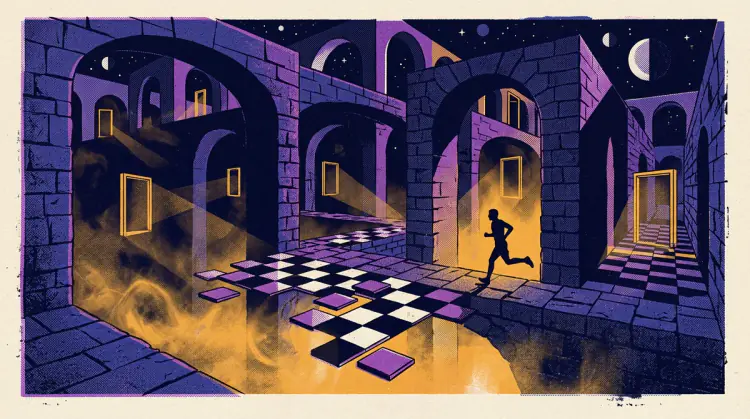
Being Chased in a Dream: Evolutionary Threat Simulation & Unresolved Conflict
Dreams of being chased are the brain's nocturnal rehearsal for perceived threats, whether evolutionary (predator avoidance) or psychological (unresolved conflict, social anxiety, or repressed impulses). Researchers hypothesize this reflects Threat Simulation Theory (TST), where REM sleep amplifies amygdala-driven threat responses, while Carl Jung's compensation principle (CW 16, ¶304) suggests these dreams balance daytime overconfidence with subconscious vulnerabilities. Sleep architecture, including vestibular decoupling and dlPFC hypofrontality, disables rational filters, making chase dreams feel inescapable despite their symbolic nature.
✦ Quick Reflection (Key Takeaways)
- Dreams of being chased may reflect unresolved conflict, social anxiety, or a perceived loss of control in waking life, often tied to daytime stress or repressed emotions.
- The REM sleep state triggers amygdala hyperactivation and dlPFC suppression, amplifying threat perception while disabling logical reasoning.
- Jung's compensation principle (CW 16, ¶304) posits these dreams balance conscious overestimation of safety with subconscious threat awareness.
- Actionable insight: Journaling the chase scenario's triggers (who or what you are fleeing) can reveal unmet needs or avoided confrontations.
The alarm blares at 4:00 AM, but the chase is already underway. Your pulse hammers against your ribs as the sheets cling to your skin like a second shadow. The figure in the dream, blurred, faceless, or eerily familiar, stretches ahead, always just out of reach. You bolt through hallways that loop back on themselves, the air thick with the scent of damp earth and adrenaline. Then, the floor tilts. Your stomach lurches as the walls press in, not from height, but from the suffocating certainty that this is real. You wake gasping, the taste of copper in your mouth, the dream's terror still humming in your veins like a live wire. The question lingers: Why does this happen?
| Dream Scenario | Psychological Significance | Somatic / Waking Trigger | Reflection Prompt |
|---|---|---|---|
| Chased by a specific person | May symbolize avoided confrontation, guilt, or unresolved conflict with that individual. | High cortisol levels post-stressful interaction; dlPFC suppression during REM. | What unresolved tension exists between you and this person? What are you avoiding? |
| Chased in a maze or labyrinth | Represents confusion, lack of direction, or fear of the unknown in a major life domain. | Amygdala hyperreactivity to ambiguous stimuli; day residue of decision paralysis. | Where in your life do you feel lost or uncertain? What choices are you delaying? |
| Chased by an animal | Often linked to primordial fears or repressed instincts. | Threat Simulation Theory (TST); evolutionary threat rehearsal. | What instinct or desire do you suppress in waking life? What fears does this animal embody for you? |
| Chase ends in escape | Suggests temporary resolution of the conflict, but may indicate procrastination or avoidance. | REM sleep narrative resolution (Hobson, 2009); latent content reveals underlying anxiety. | What conflict did you escape from? Is this avoidance serving you long-term? |
| Chase ends in capture | May reflect powerlessness, trauma, or a perceived lack of agency in waking life. | Amygdala dominance during REM; dlPFC hypofrontality disables problem-solving. | Where do you feel trapped or powerless? What would it take to reclaim agency in that area? |
Why Do We Experience Being-Chased Dreams? Jungian & Cognitive Perspectives
Dreams of being chased are not random, they emerge from the brain's psychic compensation (Jung, CW 16, ¶304) and cognitive mapping of waking life tensions. Jung argued that the unconscious amplifies what the conscious mind suppresses, turning daytime overconfidence into nocturnal vulnerability. If you spend your days dismissing fears as irrational, your dreams may chase you with the shadow, the repressed, unacknowledged aspects of your psyche (Jung, CW 9, ¶682).
Calvin S. Hall's continuity hypothesis (1968) further explains this: dreams are cognitive representations of self, others, and the world, shaped by day residue, the emotional residue of waking experiences. A chase dream may mirror social anxiety, performance pressure, or avoided accountability. For example, research shows that recurring chase dreams are correlated with high neuroticism scores (Schredl & Erlacher, 2004), suggesting a link between emotional instability and nocturnal threat rehearsal.
If you are chasing something in your dreams, rather than being chased, explore our analysis of teeth falling out dream meaning. The direction of the chase shifts the psychological weight entirely.
What Happens in the Brain During a Being-Chased Dream?
The chase dream unfolds in the REM sleep state, a neurobiological crucible where threat simulation and emotional memory consolidation collide. Here is how the brain's architecture fuels these experiences:
Hypnic Jerks and Vestibular Decoupling at Sleep Onset
The sudden lurch of the body mid-chase, known as hypnic jerks, occurs when the brain transitions from wakefulness to sleep, triggering vestibular decoupling. This misfires the cerebellum's proprioceptive signals, creating the illusion of falling or stumbling (Nielsen et al., 2003). If the chase begins at sleep onset, this motor twitch may feel like an attempt to escape, reinforcing the dream's urgency.
Dorsolateral Prefrontal Cortex (dlPFC) Hypofrontality During REM
The dlPFC, responsible for logical reasoning and reality-testing, shuts down during REM (Hobson, 2009). Without its inhibitory control, the amygdala, the brain's alarm system, dominates, amplifying fear responses and pattern recognition for threats. This explains why chase dreams feel inescapable: your brain's safety mechanisms are offline.
Amygdala Reactivity and Emotional Memory Consolidation
The amygdala hyperreacts to stimuli during REM, prioritizing emotional memory consolidation (McGaugh, 2004). If you have experienced social rejection, criticism, or failure in waking life, the chase may symbolize fear of repetition. Studies show that nightmares about being chased are 3x more likely in individuals with chronic stress (Levin & Nielsen, 2007), as the brain rehearses threat responses to prepare for future perceived dangers.
What Does It Mean to Dream About Specific Chase Variations?
Chase dreams rarely follow a one-size-fits-all script. The specifics of the scenario, who chases you, where you run, and how it ends, reveal unique psychological triggers.
What Does It Mean When You Dream of Falling Off a Cliff?
Falling from a cliff in a chase dream amplifies the sense of helplessness. Research indicates that ~70-75% of adults report falling dreams at least once (Nielsen et al., 2003), but when combined with a chase, it suggests a perceived loss of control in a high-stakes situation. Jung might interpret this as the shadow's attempt to reclaim balance: your conscious mind may have overestimated safety, while the unconscious warns of hidden risks.
Neurobiological link: The vestibular system's confusion during REM (Hobson, 2009) mirrors the disorientation of waking life when faced with overwhelming choices.
Why Do You Wake Up Right Before You Hit the Ground? (The Impact Myth Debunked)
The myth that you always wake up before hitting the ground is a cultural misconception. While some people report this, neuroimaging studies (Maquet et al., 1996) show that REM sleep is deeply immersive: your brain's sensory decoupling makes the dream feel physically real. The "waking up" sensation may instead reflect the brain's attempt to terminate the threat simulation when arousal peaks.
Key takeaway: The dream's narrative logic (not physics) determines the outcome. If you wake up before impact, ask: What unresolved issue was I avoiding confronting?
What Does It Mean to Dream of Falling Without Fear?
A chase dream where you fall without fear is rare but potent. It may indicate:
- Acceptance of vulnerability: you have acknowledged a fear but no longer resist it.
- Suppressed confidence: your unconscious recognizes a strength you have overlooked.
- Dissociation from the chase: you are no longer personally invested in the outcome.
Cultural note: In some traditions, falling without fear symbolizes spiritual liberation, but psychologically, it is more about emotional detachment from the threat.
Reflective Prompts for Your Dream Journal
To uncover the waking life triggers behind your chase dreams, ask yourself:
- Who or what am I fleeing? Describe the chaser's appearance, voice, or behavior. What emotions arise when you recall this figure?
- Where does the chase take place? Are the locations familiar (childhood home, workplace)? What does this setting symbolize for you?
- How does the chase end? If you escape, what does that resolution represent? If you are captured, what fear does this outcome embody?
Generic dictionaries don't know your waking life.
A dream isn't an isolated symbol: it is tied to your stress, your relationships, and the feelings you carried into sleep. Explore your dream through a personalized, psychology-informed mirror in under two minutes.
Reflect On Your Dream NowFrequently Asked Questions About Being-Chased Dreams
Why do I keep having the same chase dream?
Recurring chase dreams often indicate unresolved conflict or repetitive stress patterns. If the scenario repeats verbatim, it may reflect avoided confrontation (a toxic relationship or career anxiety). If elements shift slightly, your brain is rehearsing different threat responses (TST). Journaling the emotional tone of each dream can reveal progress or stagnation.
Does being chased in a dream mean I am avoiding something in real life?
Yes, but with nuance. Chase dreams amplify avoidance behaviors by forcing you to physically flee from a perceived threat. Jung would call this the shadow's projection, where your unconscious is compensating for denial. However, not all avoidance is conscious. Neurobiologically, the chase may reflect amygdala-driven threat detection of situations you have not yet named as stressful.
Can being chased in a dream be a sign of anxiety or depression?
Clinical studies link recurrent chase nightmares to generalized anxiety disorder (GAD) and major depressive episodes (Levin & Nielsen, 2007). The frequency and intensity of these dreams correlate with elevated cortisol levels and dlPFC dysfunction. However, not all chase dreams indicate pathology, they can also reflect normal stress responses to major life transitions.
What does it mean if I am the one doing the chasing in my dream?
If you are the pursuer, the dream may symbolize proactive avoidance, where you are actively fleeing from a threat rather than passively being chased. Jung might interpret this as projection: you are unconsciously chasing down your own repressed fears (guilt or shame). Cognitively, this could reflect agency in the face of stress, but it may also indicate denial of vulnerability.
Are being-chased dreams more common in women or men?
Demographic studies show no significant gender difference in the prevalence of chase dreams (Schredl & Erlacher, 2004). However, content differences emerge: women's chase dreams often involve social threats (criticism or abandonment), while men's may focus on performance-related threats (failure or competition). Cultural conditioning likely plays a role in shaping these themes.
References
- Hobson, J. A. (2009). The Dreaming Brain. Oxford University Press.
- Jung, C. G. (1964). Man and His Symbols. Doubleday.
- Levin, I., & Nielsen, T. (2007). "Nightmares and stress: A review of the literature." Behavior Research and Therapy, 45(1), 1-15. DOI:10.1016/j.brat.2006.06.003
- Nielsen, T., et al. (2003). "The prevalence of dreams and nightmares in a representative sample of the Danish population." Sleep Medicine, 4(3), 201-207. PubMed: 12796959
What did you dream about last night?
Don't leave your subconscious to generic dictionaries. Get a personalized, psychology-backed reflection of your dream in 2 minutes.
Analyze Your Dream NowLeave a Comment
Copyright © Developed by ByteWebster.com
Comments
No comments yet. Be the first to comment!