
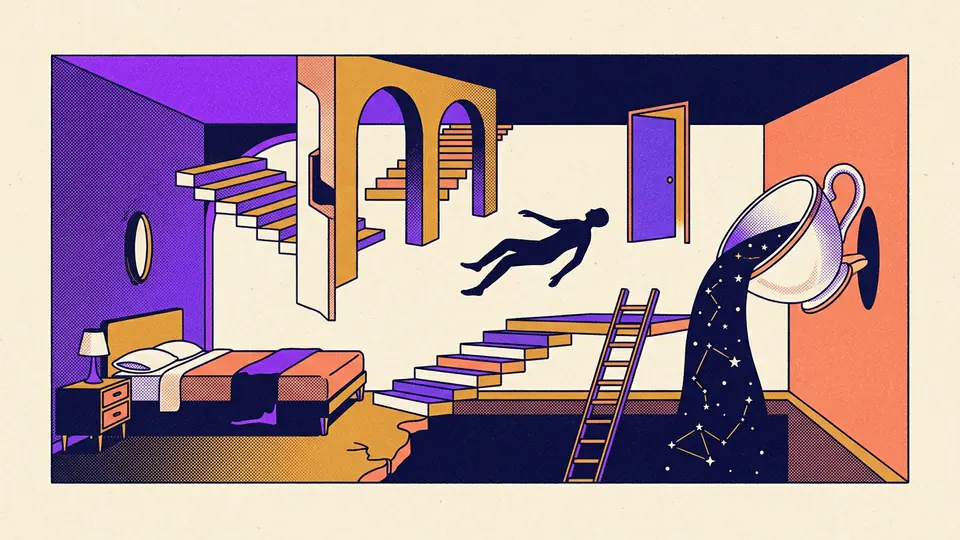
Why Do You Dream of Falling? The Science & Psychology Explained
Dreams about falling most often reflect acute waking stress, a perceived loss of emotional or professional control, or physiological sleep-onset motor twitches known as hypnic jerks. Psychological models suggest falling dreams compensate for conscious overconfidence or unacknowledged vulnerability, while neurobiology points to sensory vestibular decoupling during sleep transitions.
✦ Quick Reflection (Key Takeaways)
- Core Meaning: Falling dreams frequently mirror an acute perceived loss of control, support, or emotional stability in waking life.
- Jungian Compensation: Often acts as a psychic counterweight to daytime hubris, rigid perfectionism, or unacknowledged vulnerability.
- Neurobiological Trigger: Strongly associated with sleep-onset hypnic jerks and vestibular decoupling as muscle tone relaxes.
- Actionable Insight: Note whether the descent ends in terror or weightless acceptance to identify whether the waking trigger is panic or surrender.
The alarm jolts you awake at 4:00 AM, the bedroom cold and pitch-black. Your chest heaves. Your fingers claw at the bedsheets, searching for solid ground that was not there a second ago. Your heart is hammering against your ribs, convinced your body just plummeted through empty sky. You didn't hit the ground. You never do. But the visceral sensation of gravity ripping away remains stuck in your throat.
Why Do You Dream About Falling?
Dreaming about falling signifies an acute subconscious reaction to losing perceived control, emotional stability, or psychological footing in your waking life. Rather than predicting literal misfortune, researchers suggest that the subconscious utilizes the sensation of freefall to mirror unexpressed anxieties, sudden life transitions, or situations where conscious coping mechanisms feel inadequate.
At-A-Glance: Falling Dream Scenarios & Meanings
| Dream Scenario | Psychological Significance | Somatic / Waking Trigger | Reflection Prompt |
|---|---|---|---|
| Plummeting from a Cliff Edge | Sudden loss of control over a major life decision or milestone | Imposter syndrome; taking on excessive career responsibility | Where am I stepping off an emotional edge without a safety net? |
| Falling into Deep, Dark Water | Emotional flooding; fear of being engulfed by unexpressed grief | Suppressed vulnerability; boundary collapse in personal relationships | What emotional depth am I actively avoiding facing during the day? |
| Tripping and Falling Forward | Fear of failure or public embarrassment right before completion | Performance anxiety; hyper-critical self-monitoring | Am I rushing ahead without checking the ground beneath my feet? |
| Slow-Motion Floating Downward | Surrender; accepting that an uncontrollable situation has ended | Gradual burnout; relief following a prolonged conflict | Am I finally releasing an exhausting struggle that cannot be won? |
Why Do We Experience Falling Dreams? Jungian & Cognitive Perspectives
Traditional folklore claimed that hitting the ground in a dream meant physical death—a persistent myth with zero clinical or empirical validity. Modern analytical psychology views falling through a radically different lens.
Jung’s Compensation Principle
Carl Jung observed that dreams act as a compensatory mechanism, actively balancing one-sided conscious attitudes. When someone adopts an overly rigid, ambitious, or inflated conscious stance (hubris), the unconscious mind frequently responds with an equal downward pull:
"The dream compensates for the shortcomings of the conscious attitude. A person whose conscious idea of himself is too high falls in his dreams, reminding him of his earthy humanity."
— Carl G. Jung, Collected Works, Vol. 16, ¶304
If you are carrying intense pressure to remain flawless, infallible, or constantly in control, psychological observations indicate that the psyche responds with freefall. The dream forces a downward descent to remind you that emotional ground exists only when you surrender the illusion of total control. Much like dreams of teeth falling out, which reflect vulnerability and loss of personal agency, falling dreams force a visceral encounter with instability.
Calvin Hall’s Cognitive Mapping
Cognitive dream theorist Calvin S. Hall posited that dreams are not arbitrary noise; they are direct visual representations of how we view ourselves, others, and our environment (Hall, 1953). A falling dream visually maps an environment perceived as unstable or unsupported. If a close relationship, financial anchor, or corporate role feels precarious, Hall's continuity hypothesis suggests that the brain translates this lack of waking support into absent floorboards.
What Happens in the Brain During a Falling Dream?
While psychological stress fuels the narrative, neurobiology supplies the visceral physical shock.
Hypnic Jerks and Vestibular Decoupling at Sleep Onset
If your falling dream happens within minutes of closing your eyes, you are likely experiencing a hypnic jerk (sleep-onset myoclonus). As your nervous system transitions into Non-REM sleep, muscle tone drops sharply. Neuroscientists hypothesize that if you are exhausted, stressed, or sleep-deprived, the brain's vestibular system may misinterpret this rapid drop in muscular tension as a physical plummet through space, triggering a sudden compensatory reflex to catch you (Valko et al., 2011).
Dorsolateral Prefrontal Cortex Hypofrontality During REM
During REM sleep, neuroimaging shows that the dorsolateral prefrontal cortex (dlPFC)—the logical, analytical command center of the brain—is largely de-activated (Muzur et al., 2002). Meanwhile, the limbic system, particularly the amygdala, exhibits hyperactivation. Without your rational brain active to question why you are suspended in mid-air, the emotional circuits accept the sensation as immediate, terrifying reality.
Motor Atonia and Sensory Conflict
During REM sleep, the brainstem induces motor atonia (temporary muscular paralysis) to prevent you from physically enacting your dreams. When sensory circuits register movement without corresponding proprioceptive feedback from muscles, a disorienting sensation of floating or falling can result, sharing neurological pathways with episodes of sleep paralysis.
What Does It Mean to Dream About Specific Falling Scenarios?
What Does It Mean When You Dream of Falling Off a Cliff?
Dreaming of falling from a cliff or precipice typically correlates with feelings of being pushed to your emotional limits. Clinical dream observations suggest this motif surfaces when an individual faces a high-stakes decision where staying put feels impossible, yet moving forward carries severe uncertainty.
Why Do You Wake Up Right Before You Hit the Ground? (The Impact Myth Debunked)
The widespread myth that hitting the ground in a dream causes physical death is biologically unfounded. In reality, you wake up right before impact because the sudden surge in adrenaline and autonomic nervous system arousal spikes your heart rate, breaking through REM sleep atonia and forcing an abrupt awakening before the dream narrative can conclude.
What Does It Mean to Dream of Falling Without Fear?
If you feel weightless, peaceful, or oddly serene while falling, psychological models suggest your subconscious has transitioned from resistance to acceptance. This sensation often appears after a difficult decision has been finalized—such as resigning from an unsustainable job or letting go of an irreconcilable conflict. In contrast to the soaring agency found in flying dreams, peaceful falling represents the psychological wisdom of voluntary surrender.
How Common Are Falling Dreams?
Empirical surveys on dream themes indicate that falling is among the most universal human dream motifs, reported by approximately 70% to 75% of adults at least once in their lives (Nielsen et al., 2003). Its universal prevalence points to a blend of evolutionary threat rehearsal and shared mammalian neurobiology.
Reflective Prompts for Your Dream Journal
To extract meaning from this morning's dream, reflect upon these three questions:
- Where in my waking life this week did I feel unsupported or forced to perform without certainty?
- What conscious standard or expectation am I clinging to that is becoming too heavy to hold?
- If falling is simply an invitation to land, what part of my life needs to be grounded right now?
Generic dictionaries don't know your waking life.
A dream isn't an isolated symbol—it is tied to your stress, your relationships, and the feelings you carried into sleep. Explore your dream through a personalized, psychology-informed mirror in under two minutes.
Reflect On Your Dream NowFrequently Asked Questions About Falling Dreams
Does dreaming of falling mean something bad will happen?
No. Falling dreams do not predict the future. Psychological research demonstrates they are cognitive reflections of current waking emotional vulnerability, stress, or sleep-onset muscle twitches, not supernatural omens or forewarnings.
What is the difference between a falling dream and a hypnic jerk?
A hypnic jerk is a physiological myoclonic twitch occurring at sleep onset, often accompanied by a momentary falling hallucination. A falling dream occurs during deeper REM sleep with an extended emotional narrative.
Why do falling dreams feel so intensely real?
During REM sleep, the dorsolateral prefrontal cortex is quiet while the amygdala is hyperactive. Without logical reality-testing, your brain processes the emotional and physical sensation of freefall as an immediate, genuine reality.
Can falling dreams be prevented?
Reducing pre-sleep caffeine, managing daytime anxiety, practicing progressive muscle relaxation, and maintaining consistent sleep hygiene can significantly decrease both sleep-onset hypnic jerks and anxiety-driven falling dreams.
References
- Hall, C. S. (1953). A cognitive theory of dreams. The Journal of General Psychology, 49(2), 273-282. https://doi.org/10.1080/00221309.1953.9710091
- Hobson, J. A. (2009). REM sleep and dreaming: towards a theory of protoconsciousness. Nature Reviews Neuroscience, 10(11), 803-813. https://doi.org/10.1038/nrn2716
- Jung, C. G. (1966). The Practice of Psychotherapy: The Collected Works of C. G. Jung (Vol. 16). Princeton University Press. (Original work published 1954).
- Muzur, A., Pace-Schott, E. F., & Hobson, J. A. (2002). The prefrontal cortex in sleep. Trends in Cognitive Sciences, 6(11), 475-481. https://doi.org/10.1016/S1364-6613(02)01992-7
- Nielsen, T. A., Zadra, A. L., Simard, V., Saucier, S., Stenstrom, P., Smith, C., & Kuiken, D. (2003). The typical dreams of Canadian university students. Dreaming, 13(4), 211-235. https://doi.org/10.1037/1053-0797.13.4.211
- Valko, P. O., Hauser, S., Sommerauer, M., Werth, E., & Baumann, C. R. (2011). Hypnic jerks and sleep starts: A polysomnographic study. Journal of Sleep Research, 20(3), 441-447. https://doi.org/10.1111/j.1365-2869.2010.00902.x
Clinical Disclaimer: This analysis is for educational and reflective purposes and does not constitute clinical psychological diagnosis or medical advice. If recurrent falling dreams or severe sleep-onset twitches cause sleep deprivation or distress, consult a board-certified sleep specialist or licensed mental health professional.
What did you dream about last night?
Don't leave your subconscious to generic dictionaries. Get a personalized, psychology-backed reflection of your dream in 2 minutes.
Analyze Your Dream NowLeave a Comment
Copyright © Developed by ByteWebster.com
Comments
No comments yet. Be the first to comment!